
Faced MDF is a medium-density fibreboard with a decorative surface - usually melamine-impregnated paper - pressed onto one or both faces. The MDF core gives a dense, uniform edge that machines and profiles cleanly; the facing supplies the finish. It is the standard substrate where a panel has to be routed, wrapped, painted or given a deep surface texture.
Also called melamine-faced MDF, MF-MDF, decorative MDF, or 贴面密度板 · Updated October 2026
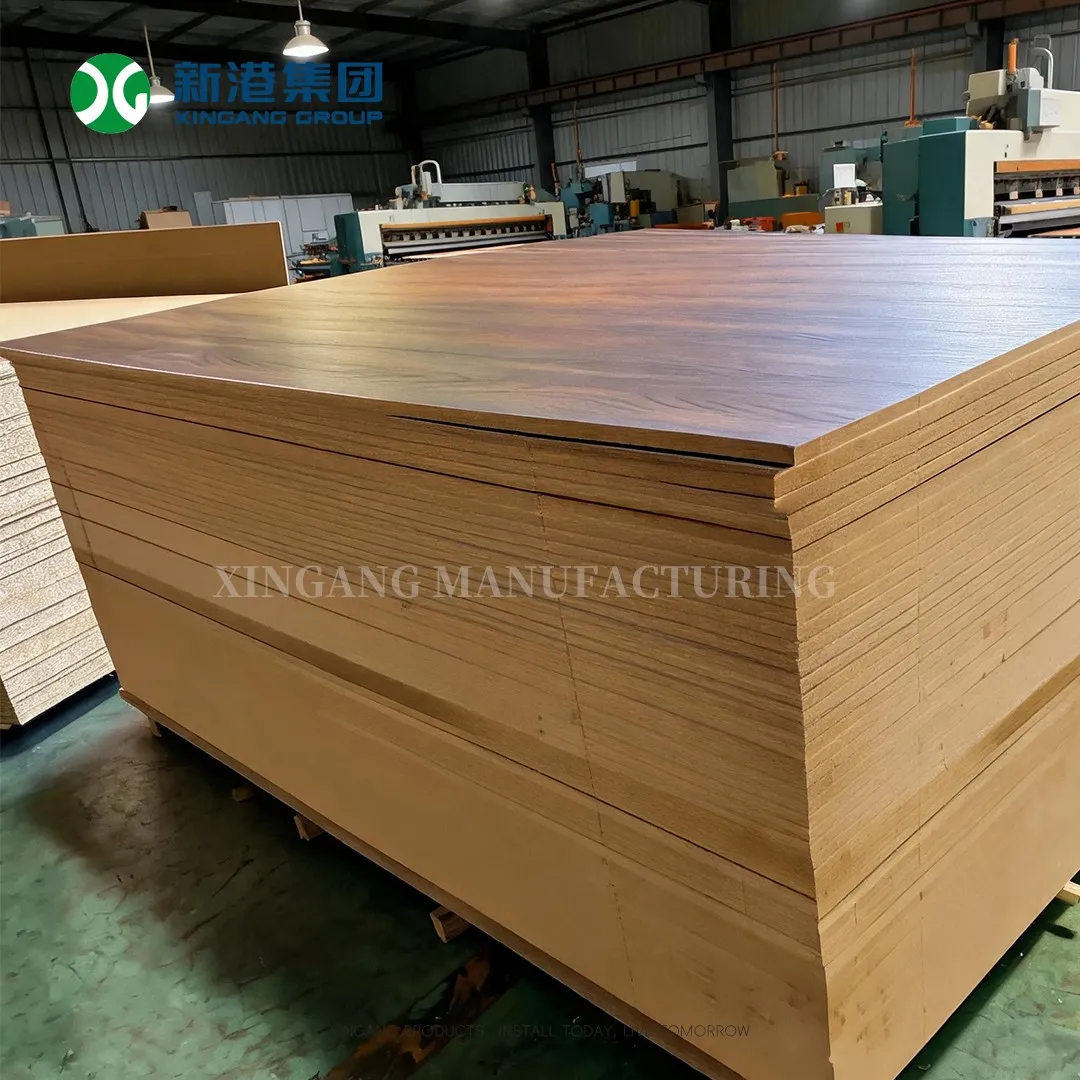
Faced MDF panels with a walnut woodgrain decor, straight off the press line. Image: Xingang Group
The five things that define the panel
- The core is refined wood fibre, not particles - which is why there is no grain direction and no particle boundary to telegraph through the face.
- Density decides the class: LDF, MDF or HDF, under EN 316 and EN 622-5.
- MDF is graded separately for dry and humid conditions, and the grade is independent of the decor.
- Its commercial advantage is the edge: MDF can be routed, profiled, painted and banded without the filling that particleboard requires.
- Its weaknesses are water and weight - standard MDF swells when wet and is the heaviest of the common furniture substrates.
What is inside a faced MDF panel?
MDF is made by refining wood into fibre, blending it with resin, drying the blend and pressing it into a uniform mat under heat and pressure. Because the fibre is broken down and re-formed, the panel has the same properties in every direction - no grain, no knots, no voids. That uniformity is the whole point of the material.
The facing is applied in the same press cycle or a second pressing step: a decorative paper saturated with melamine resin, cured onto the surface. The resin polymerises into a hard, closed film that resists water, abrasion and household chemicals, and the press plate can emboss a texture into it - from a fine matt to a deep, synchronised woodgrain where the pore structure lines up with the printed decor.
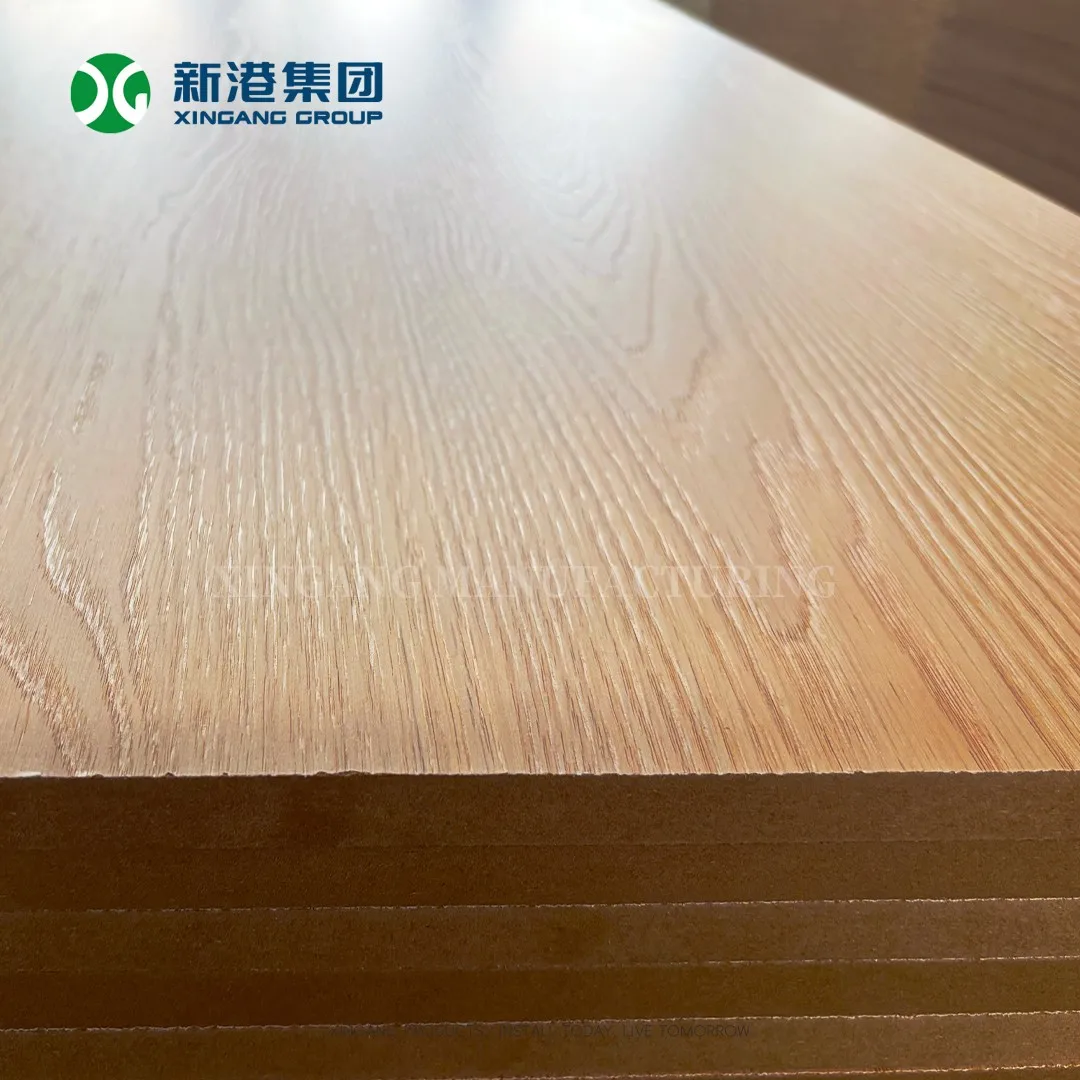
The cut edge shows what distinguishes MDF from particleboard: a dense, homogeneous fibre core with no visible particles, directly under the textured face. Image: Xingang Group
LDF, MDF or HDF - what is the difference?
The three names describe density, not quality. EN 316 sets the bands; EN 622-5 sets the performance requirements for dry-process fibreboards, including separate grades for dry and humid conditions and for load-bearing use.
| Class | Density | Where it is used |
|---|---|---|
| LDF | up to 650 kg/m³ | Lightweight panels, non-structural components, weight-sensitive furniture |
| MDF | 650–800 kg/m³ | Furniture, doors, fronts, shelving, wall panels - the general-purpose grade |
| HDF | above 800 kg/m³ | Laminate flooring cores, thin door skins, high-wear applications |
A faced MDF panel is almost always in the middle band. For furniture carcasses and fronts, standard MDF is the default; moisture-resistant (MR) MDF - usually identifiable by a tinted core - is specified for kitchens, bathrooms and any component that may see humidity.
Which facing should you choose?
| Facing | Typical use on MDF | Watch out for |
|---|---|---|
| Melamine-impregnated paper | Cabinets, wardrobe doors, shelving, wall panels, retail fit-out | Edge banding must match decor and texture |
| Wood veneer | Premium furniture, hotel and residential joinery | Needs lacquering; natural colour variation between batches |
| HPL (high-pressure laminate) | Worktops, contract and hospitality surfaces | Higher cost; separate bonding step |
| PET film | Matt, fingerprint-resistant kitchen and wardrobe fronts | Softer surface than melamine |
| UV-cured lacquer | High-gloss and super-matt fronts | Edges and cut-outs must be finished in the same plant |
| PVC / PP foil, 3D wrapped | Profile-wrapped doors, curved and moulded edges | Bond quality depends on the wrapping line |
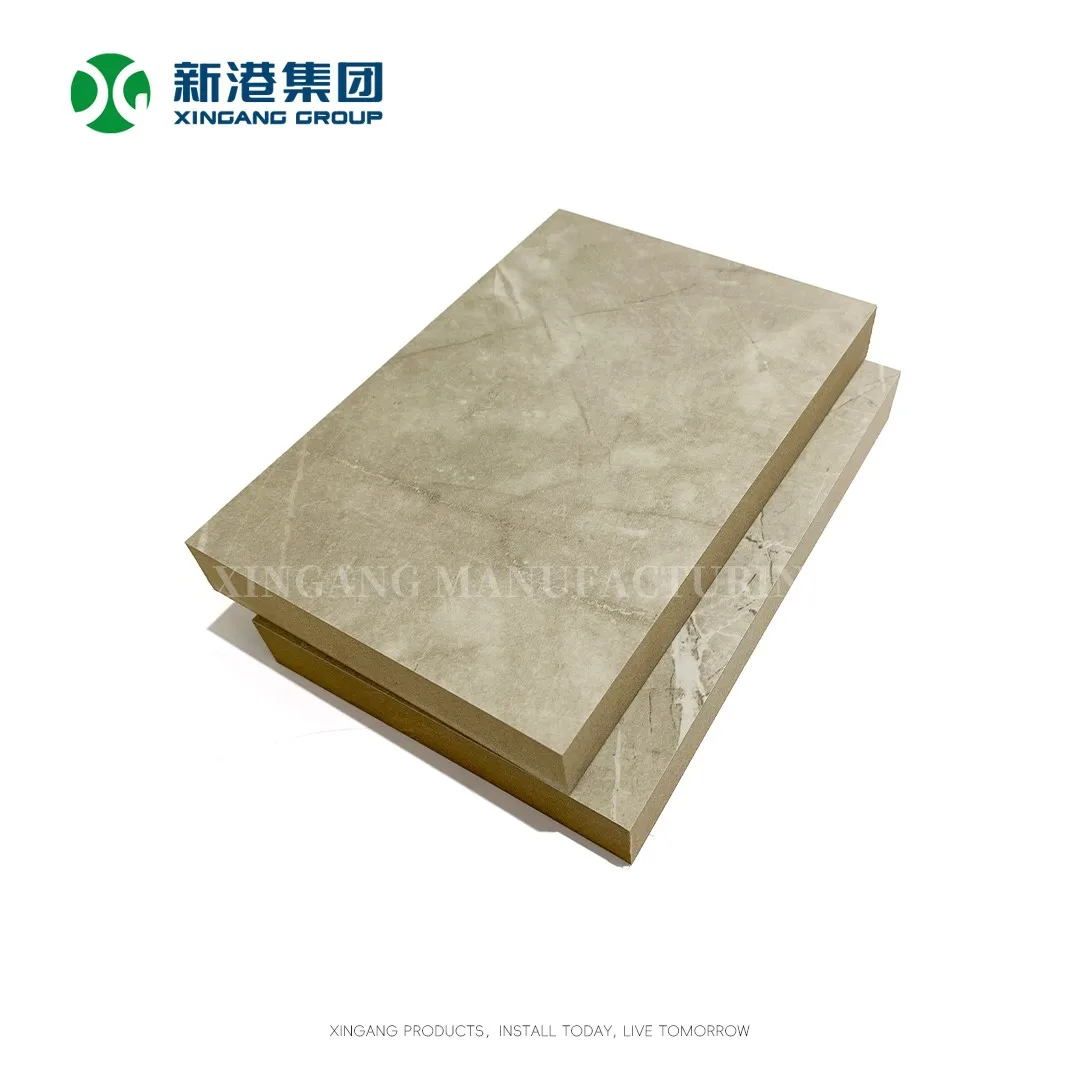
Stone and marble decors on MDF - a growing category for wall panels and kitchen fronts.
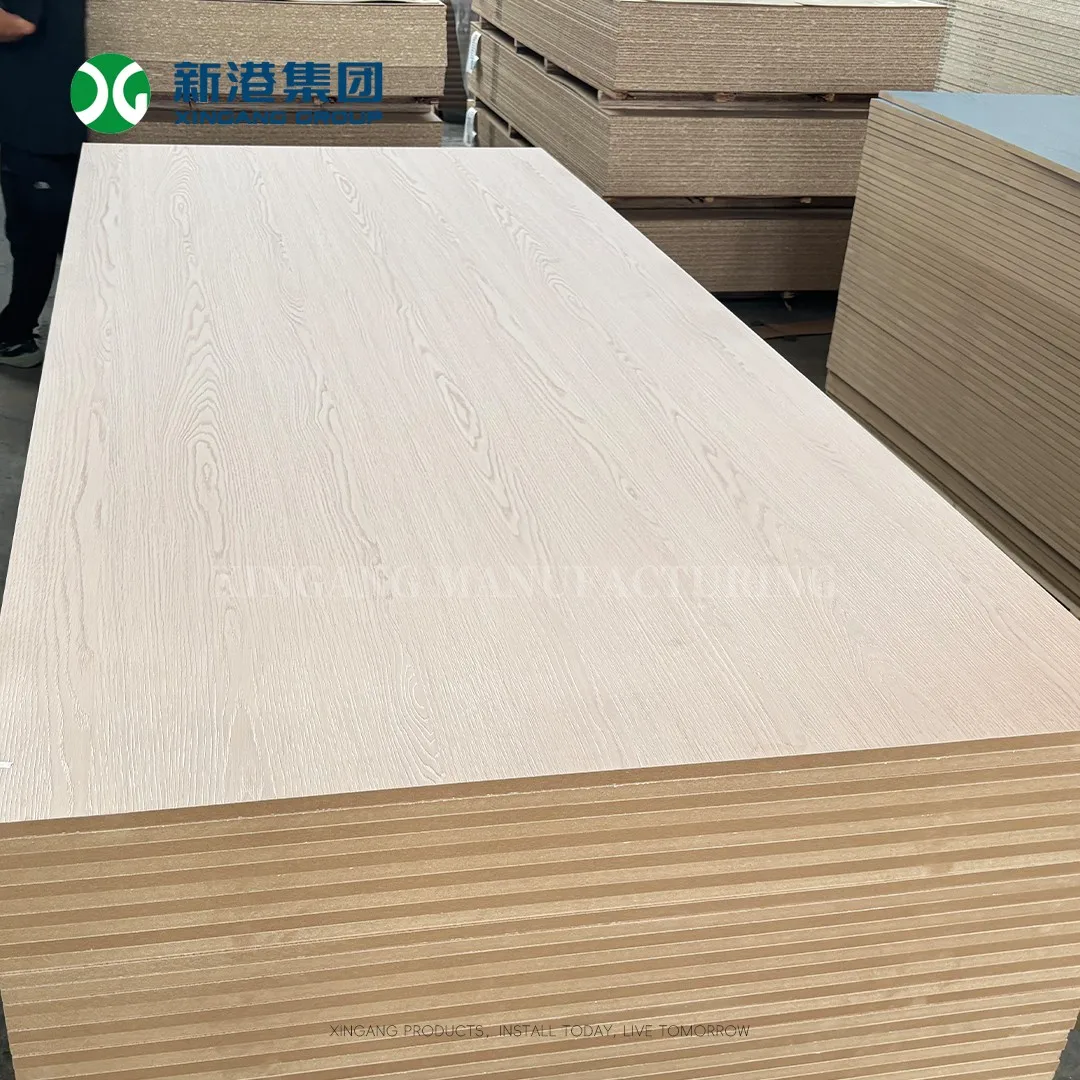
Light oak decor with a synchronised pore texture.
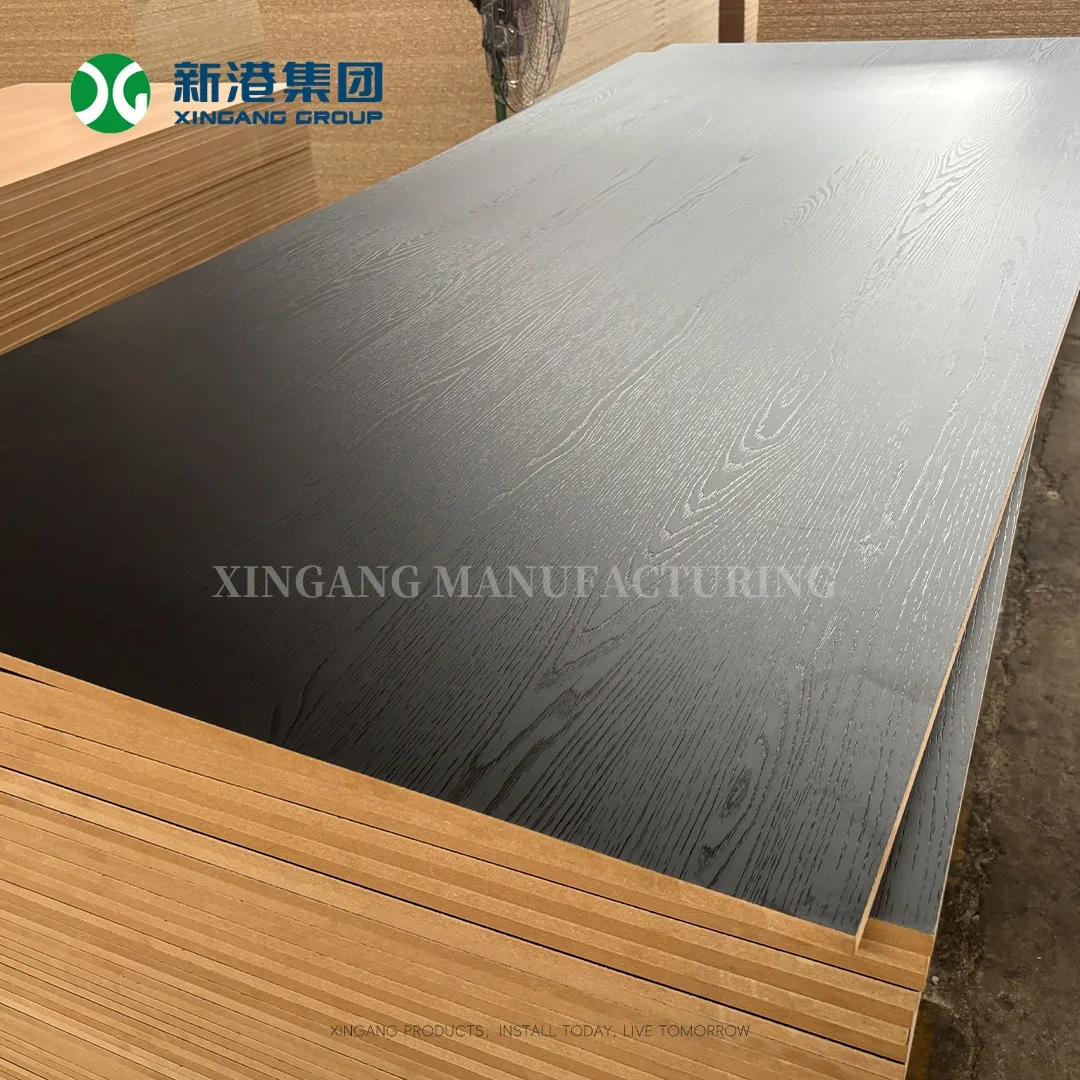
Dark woodgrain decor, embossed to follow the printed grain.
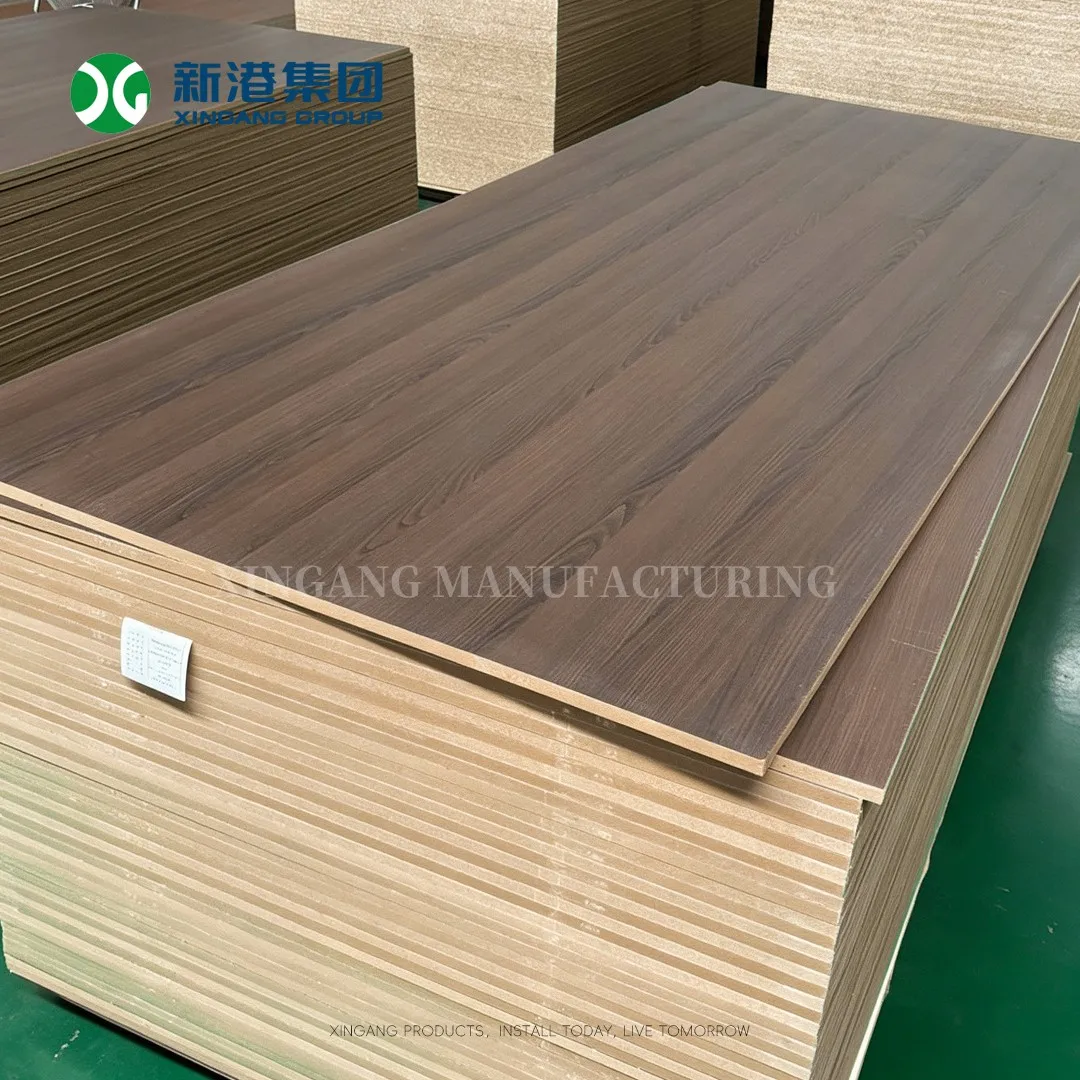
Walnut decor stacked for packing. Images: Xingang Group
Why does MDF take a facing better than particleboard?
Two reasons, both structural. First, the surface is closed and uniform, so a thin decor paper presses onto it without the risk of a particle pushing through or a void collapsing underneath. Second, the edge behaves like the face: cut MDF leaves a dense, sandable edge that can be profiled, painted or wrapped, whereas a cut particleboard edge exposes coarse chips that must be filled before it can be finished.
That is why routed and moulded doors, curved components and high-gloss lacquered fronts are almost always MDF, and why deep embossed textures hold their definition on an MDF substrate.
How is faced MDF specified?
- Core grade - standard MDF for dry interiors, MR (moisture-resistant) MDF for kitchens and bathrooms, HDF only where density is the requirement.
- Density - typically 700–800 kg/m³. An 18 mm panel at 750 kg/m³ weighs roughly 40 kg in 1220 × 2440 mm, against about 36 kg for a comparable particleboard panel; weight matters in freight and in hinge selection.
- Thickness - 18 mm is the carcass standard; 25 mm for worktops and long spans; 8–12 mm for door skins and back panels.
- Facing and texture - decor code, finish (matt, textured, gloss), and whether the pore is synchronised with the print.
- Formaldehyde class - E1 as a minimum, or E0 / ENF where indoor air quality is a selling point; CARB Phase 2 and TSCA Title VI for the United States.
- Edge treatment - banded, painted or raw, and the banding thickness: 0.4 mm for flat fronts, 1–2 mm where the edge is handled or rounded.
What are the limitations?
MDF is unforgiving in three specific ways. It swells - standard MDF that takes on water does not return to its original thickness, so a swollen panel is a replacement, not a repair. Its edge screw-holding is moderate; fixings into thin MDF edges should be confirmats, dowels or cam fittings, and 12 mm edges should not be screwed at all. And it generates fine dust when cut or routed, which requires proper extraction and respiratory protection on the shop floor - a real cost item that is often left out of the quotation.
Frequently asked questions
Is faced MDF stronger than faced particleboard?
Not in bending. MDF is denser and machines better, but density is not strength. Its advantage is the finish and the edge, not the load capacity.
Can faced MDF be used in bathrooms?
Only moisture-resistant MDF, and only with every cut edge sealed. No MDF is suitable for permanently wet areas or exterior use.
Does MDF need edge banding?
For exposed edges, yes - or a painted and sealed edge. An unsealed MDF edge absorbs water and paint unevenly, and it will show.
Can MDF be painted?
Yes, and it is the best of the common substrates for paint - provided the edges and any routed areas are primed and sealed first.
Which is better for kitchen cabinet doors, MDF or particleboard?
MDF where the door is routed, profiled, wrapped or painted; particleboard where it is flat, melamine-faced and cost is the driver.